 News & Updates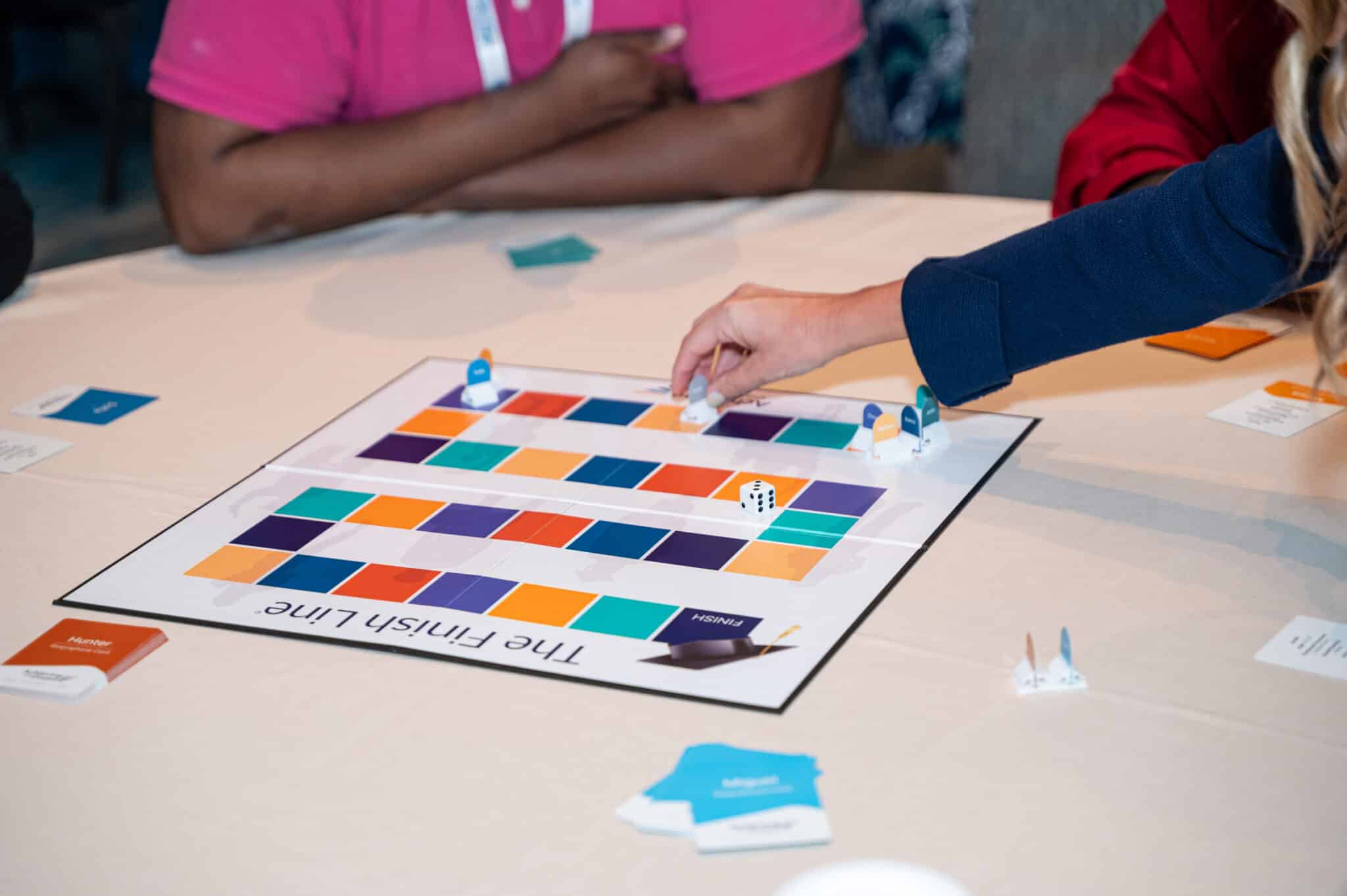
Last February, at DREAM 2024, Achieving the Dream unveiled an updated version of its very own board game, The Finish Line. First launched roughly 15 years ago, the game engages players as they adopt the personas of students from historically underserved populations and face a variety of institutional, access-related, and societal factors that impact their progress through and success in community college.
With a focus on improving student success and completion rates, The Finish Line increases awareness about the need to generate opportunities and remove barriers to drive more equitable student outcomes.
The latest version features updated student personas that are more reflective of today’s students, as well as revised facilitator instructions. Each player “becomes” one of a variety of students with unique and diverse identities, such as “Anita,” a Black/African American woman in her 40s living in a rural area, “Sofia,” a nonbinary Latinx student aged 22–24 from an urban setting, “Nataani,” a Native American student in his early 20s who lives on a rural reservation, and several more.
Many colleges have had the updated Finish Line experience. At DREAM 2024, attendees from nearly 20 colleges attended a concurrent session to try out the newest version of the game. Team members from more than two dozen colleges left the conference with game in hand or having placed an order for one or more copies.
In addition, teams from the 15 newest Network colleges were introduced to the game in June at ATD’s Kickoff Institute in New Orleans as part of their orientation.
While the game is designed to prompt personal and institutional development and growth through collaborative conversations about how to offer holistic support to students, each college that has purchased the game uses it in ways — and for purposes — that are as unique as the student personas themselves.
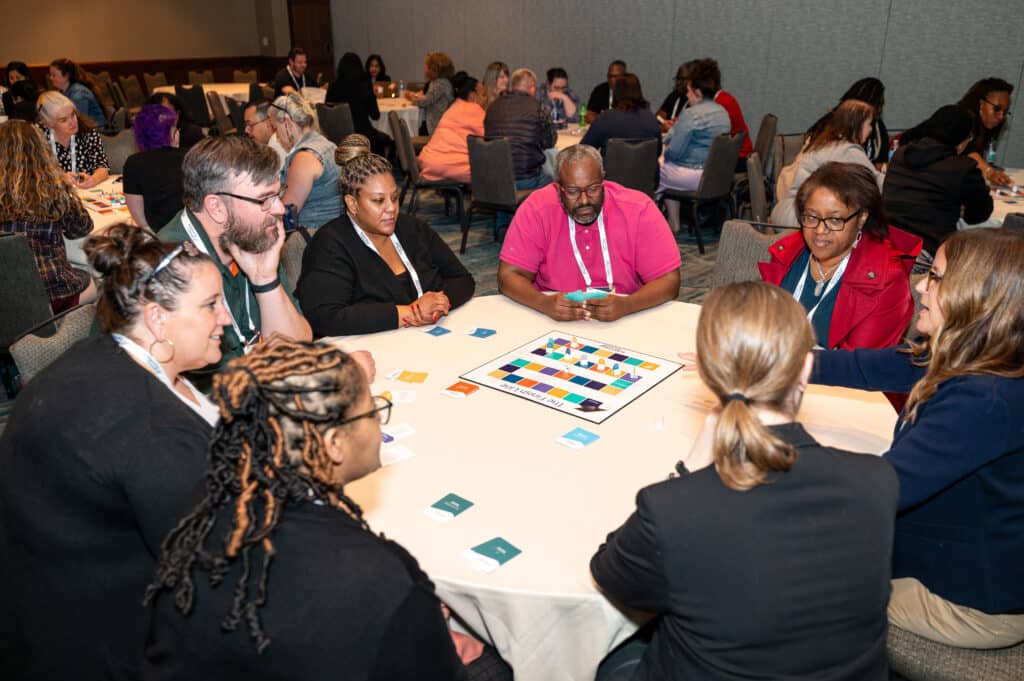
A group of DREAM 2024 attendees paying the updated Finish Line Game.

A team from Arkansas State University-Newport (ASUN), for example, who played the game at Kickoff, had such a positive experience that the institution purchased multiple copies and decided to dedicate a break-out session at its fall convocation to engaging faculty and staff en masse in gameplay.
A team from Berkshire Community College (BCC) in Massachusetts, on the other hand, played the updated version of The Finish Line at DREAM 2024 but had already played the original version, having purchased it around the time they joined the Network in 2021. They, too, relished the experience but use the game primarily for student play in small groups.
Adam Klepetar, vice president for student affairs and enrollment management at BCC, was the original purchaser of the game for his institution and was among those from Berkshire who tested out the new version at DREAM 2024. He appreciates the power of the game to unite students. “It just creates this camaraderie,” he says, “it’s a way for people to kind of rally together.”
He also finds it useful as a tool to help students get to know one another and to enable them, particularly new students, to understand others’ perspectives . “It was one of the easiest ways to engage and break the ice with a new group of students,” he reflects. “It’s a really good way to get to know people and contextualize both what it is to be a community college student and the diversity that students bring. The characters are rich, and they bring different aspects to the table. So, you kind of step out of yourself … and think about the college experience in someone else’s shoes.”
Klepetar sees the game’s potential as a camaraderie builder not just for students but for colleagues as well. When he and other Berkshire Community College employees played the game at DREAM 2024, he witnessed that effect. “You start out with everyone a little shy. Who’s going to take the lead? Who’s going to read the directions? But by the end, all around the room, people are cheering and are excited for one another,” he recalls. “And that’s not an easy thing to engineer in 45 minutes.”
Dr. Amber Grady, dean for community outreach at Arkansas State University-Newport, agrees with this assessment. When it came time for members of ASUN’s administration to coordinate the gameplay for the fall convocation, they intentionally capitalized on the game’s ability to unite people from across the university. “We made the decision to randomly divide [employees] into groups so that they would not be with their friends, and they would not be with their departments,” she shares. “We thought it was a great way for them to experience a hands-on setting where they have none of their [familiar] colleagues and have intentional conversations about the things that directly impact or impede students’ ability to progress.” The result, she says, is that ASUN was “truly able to gain perspective from everybody.”
“People truly see a value in them being able to contribute,” she elaborates, adding that the inclusivity fostered by The Finish Line should be a factor when colleges are debating whether or not to give the game a try. “I would say to schools who are considering [the purchase] … the game is going to engage everybody. While everybody may not speak up in a conversation, everybody may not respond when a question is asked, or they might not feel like taking a survey, they will sit at a table and participate in a board game.”
But it’s not just participation for participation’s sake, Dr. Grady explains. Faculty, staff, and administrators engage, but they engage with purpose. “They’re starting to see student success work as their work,” she notes, because the game has made the mission of the institution’s work with ATD more relatable to them. “The game helps us to sell our story of why [student success work] is so relevant,” she says. “It was a great way to roll out our partnership with ATD.”
In Klepetar’s view, one of the ways the game helps motivate players toward student success work is through its ability to evoke empathy for students. He says it can change faculty mindsets from one of fault-finding to one that acknowledges structural problems and looks for solutions. “It underscores the idea that, for many of our students, they are one move away from not continuing as a student. And it isn’t an academic skill issue, I would say eight or nine times out of 10,” he says. “It’s ‘I had something go wrong with my car, and I’m not going to be able to drive to campus,’ … or ‘I need to pick up more hours at my job so that I can pay to fix my car so I can get to campus, and now I’ve missed three weeks and I’m really far behind.’ And instead of thinking about that as some sort of fundamental error in the student, we can think about structurally what might we do better to serve the students.”
Ike Wheeler, ASUN’s vice chancellor for institutional advancement, echoes Klepetar’s assessment that The Finish Line is effective in evoking empathy by laying bare the tenuousness of many community college students’ life circumstances. “My hope is that empathy is the key takeaway,” he states, “and a realization of how truly frenzied some of our students happen to be — the fact that many of them are just one fell swoop away from not being able to succeed due to an unforeseen circumstance and, perhaps, the need for a bit of grace and tolerance.”
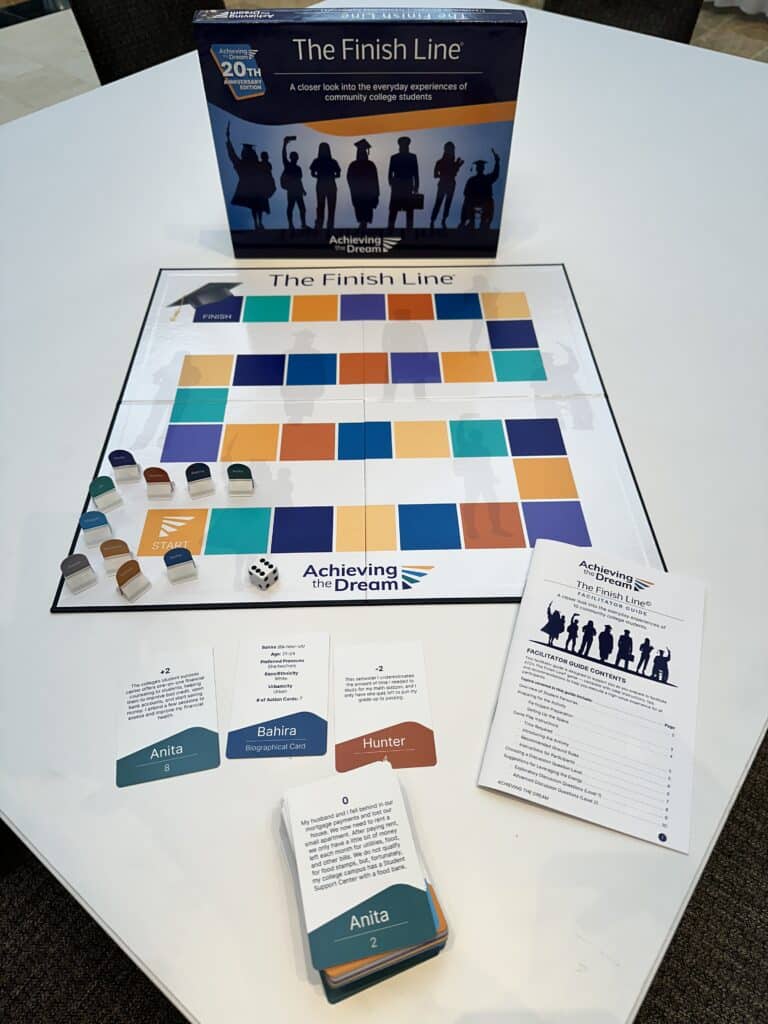
Underscoring the game’s ability to make players truly feel the unpredictability of students’ lives, Anna Westman, dean for student success and assessment at ASUN, points out how fitting it is that The Finish Line is a game of chance. “The entire concept of even rolling the dice feels relatable because I’ve noticed that for many students, their college journey can go from pretty good and stable to absolute disaster and chaos just because of one triggering event that they had absolutely no control over,” she notes.
Westman believes that making faculty more aware of students’ hurdles — and the lack of control they often have over those hurdles — goes a long way in combatting a disconnect in faculty’s minds that can lead to unrealistic expectations. “Some of us have been fortunate enough not to face too many challenges in our college journey,” she says, “which makes a game like The Finish Line even more important and relevant since it opens up the door of understanding and realizing the situations and barriers that many of our students face that we may or may not be aware of.”
As Klepetar points out, understanding someone else’s predicament is the basis for developing empathy, and empathy is what can set the wheels of change in motion. He values The Finish Line for the way it brings attention to the fact that many community college students often struggle to meet their basic needs and credits the game with spurring action at BCC. “I think one of the things that it has helped us do as professionals is lean in even further to our basic needs work,” he shares, “and it helps lead people away from the stigmatization of taking advantage of the resources we have on campus.”
But, according to Dr. Grady, the beauty of The Finish Line is that it not only highlights the big ticket items, such as access to food, housing, and reliable transportation, that institutions can take steps to provide, but it can also spark an understanding of how even seemingly small changes in behavior can have a profound effect on students. “[Players] feel a sense of ‘I can identify with that. I can relate to that. I see how a professor’s engagement benefitted the student. I see how, when [the student] had a positive interaction with the cleaning staff in the hallway, it had an impact in their ability to persist,’” she says.
As employees of both BCC and ASUN can attest, The Finish Line is much more than just a board game. It’s a transformative experience, bringing people together and reshaping the way we think about the student experience and student success work. Whether it’s played in small groups or large gatherings, with students present or absent, the game provides insights that textbooks and trainings alone often can’t deliver. It pushes community colleges to dig deeper, to see things from a different perspective, challenging them to remove barriers and embrace bold, equity-driven changes that can help every student cross the finish line.
Don’t miss your chance to play The Finish Line at DREAM 2025 at The Finish Line Game Experience session (Wednesday, Feb. 19, 2:30–3:30 p.m. ET) or to stop by ATD Central to order your copies.
Learn more about The Finish Line and purchase the game.